The Jewish Feasts of the Lord and the
Gen 1:14 [Hebrew Stone’s Edition Tanach, (O.T.) “Then God said, "Let there be lights in the expanse of the heavens to separate the day from the night, and let them be for signs and for festivals and for days and years”
Act 3:19-21 (NASB) "Therefore repent and return, so that your sins may be wiped away, in order that times of refreshing may come from the presence of the Lord; and that He may send Jesus, the Christ appointed for you, whom heaven must receive until the period of restoration of all things about which God spoke by the mouth of His holy prophets from ancient time.
If one can grasp the meaning of the Feasts of the Lord and the
Every feast points to and symbolizes Jesus the Christ – past, present and future. The 7 holy feasts occur in the 2 rain seasons – the Spring [former rain] and the fall [latter rain]. Hosea 6:3, “…and he shall come unto us as the rain, as the latter and former rain unto the earth.”
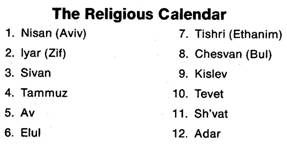
The Jewish Calendars
|
|
|
|
Solar [Babylonian] Year Calendar Translation |
|
|
Nisan (Aviv) |
March – April |
|
Lyar (Zif) |
April – May |
|
Sivan |
May – June |
|
Tammuz |
June – July |
|
Av |
July – August |
|
Elul |
August – September |
|
Tishri (Ethanim) |
September – October |
|
Chesvan (Bul) |
October – November |
|
Kislev |
November – December |
|
Tevet |
December – January |
|
Sh’vat |
January – February |
|
Adar |
February - March |
|
To maintain the relation of the lunar [moon] based calendar to the solar [sun or Babylonian] based calendar, it was periodically necessary to add a 13th month, which was called Second Adar. The additional month was later introduced automatically seven times in a lunar cycle of nineteen years; in the years 3, 6, 8, 11, 14, 17, and 19 of the cycle. The Jewish lunar calendar determined the new moon as the beginning of the month and a full moon as the middle of the month. Jewish months are generally identified by number instead of name in Scripture. The names of the twelve months are of Babylonian origin. It is very interesting that the number of days between Nisan and Tishri is always the same. Because of this, the time from the first major festival Passover in Nisan to the last major festival Feast of Tabernacles in Tishri is always the same. |
|
THE FEASTS OF THE LORD – Leviticus 23
(1) The LORD
spoke again to Moses, saying, (2)
"Speak to the sons of
SABBATH
(3) 'For six days work may be done, but on the seventh day there is a sabbath of complete rest, a holy convocation. You shall not do any work; it is a sabbath to the LORD in all your dwellings. (4) 'These are the appointed times of the LORD, holy convocations which you shall proclaim at the times appointed for them.
The Spring Festivals – The Former Rain - PASSOVER
(5) 'In the first month, on the fourteenth day of the month at twilight is the LORD'S Passover.
UNLEAVENED BREAD
(6) 'Then on the fifteenth day of the same month there is the Feast of Unleavened Bread to the LORD; for seven days you shall eat unleavened bread. (7) 'On the first day you shall have a holy convocation; you shall not do any laborious work. (8) 'But for seven days you shall present an offering by fire to the LORD. On the seventh day is a holy convocation; you shall not do any laborious work.'"
FIRSTFRUITS
(9) Then the LORD spoke to Moses, saying, (10) "Speak to the sons of Israel and say to them, 'When you enter the land which I am going to give to you and reap its harvest, then you shall bring in the sheaf of the first fruits of your harvest to the priest. (11) 'He shall wave the sheaf before the LORD for you to be accepted; on the day after the sabbath the priest shall wave it. (12) 'Now on the day when you wave the sheaf, you shall offer a male lamb one year old without defect for a burnt offering to the LORD. (13) 'Its grain offering shall then be two-tenths of an ephah of fine flour mixed with oil, an offering by fire to the LORD for a soothing aroma, with its drink offering, a fourth of a hin of wine. (14) 'Until this same day, until you have brought in the offering of your God, you shall eat neither bread nor roasted grain nor new growth. It is to be a perpetual statute throughout your generations in all your dwelling places.
SHAVOUT OR PENTECOST
(15) 'You shall also count for yourselves from the day after the sabbath, from the day when you brought in the sheaf of the wave offering; there shall be seven complete sabbaths. (16) 'You shall count fifty days to the day after the seventh sabbath; then you shall present a new grain offering to the LORD. (17) 'You shall bring in from your dwelling places two loaves of bread for a wave offering, made of two-tenths of an ephah; they shall be of a fine flour, baked with leaven as first fruits to the LORD. (18) 'Along with the bread you shall present seven one year old male lambs without defect, and a bull of the herd and two rams; they are to be a burnt offering to the LORD, with their grain offering and their drink offerings, an offering by fire of a soothing aroma to the LORD. (19) 'You shall also offer one male goat for a sin offering and two male lambs one year old for a sacrifice of peace offerings. (20) 'The priest shall then wave them with the bread of the first fruits for a wave offering with two lambs before the LORD; they are to be holy to the LORD for the priest. (21) 'On this same day you shall make a proclamation as well; you are to have a holy convocation. You shall do no laborious work. It is to be a perpetual statute in all your dwelling places throughout your generations. (22) 'When you reap the harvest of your land, moreover, you shall not reap to the very corners of your field nor gather the gleaning of your harvest; you are to leave them for the needy and the alien. I am the LORD your God.'"
The Fall Festivals – The Latter Rain - TRUMPETS
(23) Again the
LORD spoke to Moses, saying, (24)
"Speak to the sons of
ATONEMENT
(26) The LORD spoke to Moses, saying, (27) "On exactly the tenth day of this seventh month is the day of atonement; it shall be a holy convocation for you, and you shall humble your souls and present an offering by fire to the LORD. (28) "You shall not do any work on this same day, for it is a day of atonement, to make atonement on your behalf before the LORD your God. (29) "If there is any person who will not humble himself on this same day, he shall be cut off from his people. (30) "As for any person who does any work on this same day, that person I will destroy from among his people. (31) "You shall do no work at all. It is to be a perpetual statute throughout your generations in all your dwelling places. (32) "It is to be a sabbath of complete rest to you, and you shall humble your souls; on the ninth of the month at evening, from evening until evening you shall keep your sabbath."
TABERNACLES
(33) Again the
LORD spoke to Moses, saying, (34) "Speak to the sons of
The Spring Festivals – The Former Rain

Pesach or Passover
· Related Scriptures:
Exodus 12:1-16 NASB: (1) Now the LORD said to Moses
and Aaron in the
Exodus 12:21-51 NASB:
(21) Then Moses called for all the elders of
.I am the Lord your God, Who brought you out of
“Do not oppress an alien; you yourselves know how it
feels to be alien, because you were alien in
1Co 5:6 – 8 (NASB) Your boasting is not good. Do you not know that a little leaven leavens the whole lump of dough? Clean out the old leaven so that you may be a new lump, just as you are in fact unleavened. For Christ our Passover also has been sacrificed. Therefore let us celebrate the feast, not with old leaven, nor with the leaven of malice and wickedness, but with the unleavened bread of sincerity and truth”.
He was oppressed, and he was afflicted, yet he opened not his mouth: he is brought as a LAMB to the slaughter, and as a sheep before her shearers is dumb, so he openeth not his mouth.” (Isaiah 53:3-7)
Rom 3:25 (NASB) “…because in the forbearance of God He passed over the sins previously committed…”
Luke 22:15, 16 (NASB) And He said to them, "I
have earnestly desired to eat this Passover with you before I suffer; for I say
to you, I shall never again eat it until it is fulfilled in the
· Passover begins on the 14th day of the first month of the Jewish religious calendar which is Nisan or Aviv.
· God, not Moses, is the Redeemer; Moses is the heroic messenger.
·
 The MALE, unblemished lamb at the peak of its life was
brought in on the 10th day of Nisan.
The lamb represents Christ and the number ten is the number of law. Prior to the temple the Israelites lived with
and inspected the lamb for 4 days. 4 is
the number of all creation which Christ is to redeem. After the temple a lamb was chosen by the
high priest outside of
The MALE, unblemished lamb at the peak of its life was
brought in on the 10th day of Nisan.
The lamb represents Christ and the number ten is the number of law. Prior to the temple the Israelites lived with
and inspected the lamb for 4 days. 4 is
the number of all creation which Christ is to redeem. After the temple a lamb was chosen by the
high priest outside of
- Before the Jewish temple, in the doorway on the 14th of
Nisan at the appointed time, the Father would lay his hands on the head of
the lamb using his weight. This
would indicate full substitution and identification with and consecration
of the lamb and attest to the appropriateness and fitness of the
sacrifice. The lamb’s throat would
be cut and the blood applied to the top and side posts of the door. The mother would roast the lamb over an
open fire using [according to some Jewish scholars] a pomegranate stick. The pomegranate represented fruitfulness
and life due to its many seeds and ability to reproduce itself and was a
frequent ornament in Jewish societies, particularly on temple garments. The firstborn of every house whose door
was “covered with the blood” would be spared; all houses not covered by
the blood would have the firstborn killed.
Exodus 4:22, 23 (NASB)
"Then you shall say to Pharaoh, 'Thus says the LORD, "
·
After the temple
the Passover lamb could only be slain in
·
Many teach that
originally, prior to the temple, each father acting as priest and killing the
lamb for their own house symbolized
· There was only one real Passover – the first one. All others were a celebration of the first. Because conditions changed after both the deliverance from Pharaoh’s hand and the temple, the rules for subsequent Passovers changed. Blood was no longer applied to the side and top door posts; it was handled according to temple rules. Although certainly remembered, the rules regarding shoes on the feet, staff in hand, loins girded, eating in haste and not leaving the house were also relaxed.
· Scriptures related to the Passover not only clearly typify the plan of salvation and sacrifice of the Christ, they also show the nature and character of God and Christ via commanding Israel to humbly remember the conditions that led to the exodus and by demanding kindness to strangers, orphans, widows, and the downtrodden. Also, gentiles were able to partake of the protections of the Passover through faith demonstrated by obedience.
· In the 6-week period preceding Pesach, there are 5 special Sabbaths. Four are entitled after the special Torah reading of that Sabbath. The fifth takes on luster because of it's proximity to the holiday itself. See Appendix.
· Passover represents the crucifixion of Jesus. He died on Preparation Day, the day before the special Sabbath (Mark 15:24). He became our Paschal Lamb and was sacrificed on Passover. The Christian communion service commonly called the Lord’s Supper is, in fact, a Passover celebration meal [Seder] celebrated with its full revelation and meaning revealed.
- During the Passover time, a sign hung on each lamb’s neck, bearing the name of the owner of the lamb. Jesus was crucified with a sign hung over His head with the name of His Father. Studies have shown the Tetragrammaton [the Hebrew unpronounceable name of God] probably appeared over Jesus when He hung on the cross. During Bible times, messages were commonly written with the first letter of each word. An example in English: UPS, stands for United Parcel Service. The phrase "Jesus of Nazareth and King of the Jews" was written in three languages on a sign above Jesus as He hung on the cross (John 19:19). The Hebrew initials for "Jesus of Nazareth and King of the Jews" was YHWH. That is why the priest asked Pilate to change the writing.
·
Jesus died at
3PM. They hurried to place Him in the
tomb by sunset at which time [Nisan 15] the next festival – Unleavened Bread
begins. John 19:31-42 Nisan 15 is the day
HAG HAMATZOH, MATZOT OR UNLEAVENED BREAD
|
Matzo – unleavened bread |
|
|

- Related Scriptures:
Exodus 12:15-20 NASB: (15) 'Seven days you shall eat unleavened bread,
but on the first day you shall remove leaven from your houses; for whoever eats
anything leavened from the first day until the seventh day, that person shall
be cut off from Israel. (16) 'On the first day you shall have a holy
assembly, and another holy
assembly on the seventh day; no work at all shall be done on them, except what
must be eaten by every person, that alone may be prepared by you. (17)
'You shall also observe the Feast
of Unleavened Bread, for on this very day I brought your hosts out of
the
Jesus said to them, "I am the Bread (Matzo) of Life. Whoever comes to me will never be hungry..."' (John 6:35)
Luke 24:30-32 states this after the resurrection: 'Now while He was with them at table, He took the matzo and said the blessing; then He broke it and handed it to them. And their eyes were opened and they recognized Him; but He had vanished from their sight. Then they said to each other, "Did not our hearts burn within us as He talked to us on the road and explained the Scriptures to us?"'
Luke 24:35 They began to relate their experiences on the road and how He was recognized by them in the breaking of the bread.
John, a Jew who walked with Jesus recalls Jesus declaring: '...If you do not eat the Flesh of the Son of Man and drink His Blood you will not have Life in you. Anyone who does eat My Flesh and drink My Blood has Eternal Life, and I shall raise him up on the Last Day' (John 6:53-54). At the Passover before His Death, Jesus told His followers that the matzo represented His Body. Matthew 26:26 records this: 'Now as they were eating, Jesus took some matzo, and when He had said the blessing, He broke it and gave it to the disciples. "Take it and eat," He said, "this is My Body."
·
The day after
Passover, the 15th of the month of Nissan, starts the Feast of Unleavened Bread. The purging of all leaven had taken place on
Preparation Day and unleavened bread must be eaten for the length of the feast
- 7 days. Jesus was buried on Preparation
Day and is depicted as both the Passover lamb and the matzo. This day is when
At the Seder we say: "In every generation they
rise against us to annihilate us." The Egyptians broke our backs and our
spirits. The Romans destroyed the
· Leaven is symbolic of sin. It is that which gets inside and alters what it enters by puffing up. The Hebrew for leaven is “chametz” which means decay, corruption and sour” and in the Bible leaven is used symbolically of sin, slavery and corrupted doctrine. Eating unleavened bread symbolized a life of holiness.
·
The brown spots
in matzo are called bruises. 'The LORD
God of
· The Pesach Seder [Passover meal] involved 4 cups of wine which symbolized the 4 promises given to Moses from God in Exodus 6:6-7. This was a rabbinical decree from Mishna Pesachim 10:1. The rules of leavening apply to food prepared out of any of the five kinds of grain; barley, wheat, rye, oats, and spelt. Although wine is fermented, it doesn't enter into the category of leaven because it’s not made from one of these five types. Some reports indicated that possibly unfermented "raisin-wine" was the only acceptable beverage for Passover. Today only kosher wine is used for Passover. During the Seder, each participant drinks four cups of wine to recall the four expressions of redemption mentioned in the Bible (Ex. 6:6-7). God tells Moses to tell the people of Israel, "I will bring you out from under the burdens of the Egyptians, and I will rid you from under their bondage and I will redeem you with a stretched out arm and with great judgments: and I will take you to Me for a people and I will be to you a God." The four cups at the Seder represent the four expressions of redemption--bring, deliver, redeem and take. The first cup is called the cup of sanctification; the second, the cup of judgment; the third, the cup of redemption; and the fourth, the cup of the kingdom. When Jesus said, “This is my blood of the new covenant which is shed for many for the remission of sins” in Matthew 26:28, he had picked up the third cup – the cup of redemption.
A fifth cup was later added by rabbis, called the cup of Elijah. The custom of filling a fifth cup of wine for Elijah the Prophet at the seder table is relatively recent. Some families set a place at the table for Elijah and pour into a goblet called "Elijah's cup" to symbolize Elijah would be a welcome guest at the seder. Another custom is to open the door during the seder for Elijah, symbolizing bringing the Messianic age into their lives.
·
At regular
holidays and Sabbath meals two loaves of unleavened bread are placed on the
table as reminders of the shewbreads displayed in two rows by the priest in the
temple. On this particular feast a third
matzo is added for the ceremony of the Three Matzot, the three pieces of
unleavened bread. They are either placed under a napkin or in a Matzo Pouch, a
single pouch with 3 compartments called the Unity Bag. The middle piece of matzo
will be taken out and broken in half in a ceremony called “yachatz” meaning “to
break.”. One half will be placed back
inside the pouch’s middle compartment between the other two pieces of matzo,
and the other half will be wrapped inside a napkin and buried in a part of the
house. The buried broken matzo in Greek
is called “afikomen” meaning ‘that which comes last’ or possibly, “he will come
again.” It is also called the bread of
affliction or the bread of redemption. The
Hebrew for the matzo returned to the middle pouch is called Lechem Oni [the
Bread of Poverty]. After the meal, the
children will be released to try and find the buried matzo. Nothing can continue till the buried matzo is
found. The one who finds it brings it to
the father and is rewarded a silver piece or something of that nature. The host will then raise the matzo and
declare, 'All who are hungry and afflicted, come to this table and eat.' He then lifts the matzo up, blesses God for
redeeming
· The matzo of Passover is a graphic picture of the crucified body of the Messiah - the piercing, the crushing and the bruises in addition to the matzo having no leaven symbolizing no sin. This is why the LORD commanded that matzo be the bread of Passover - so that Jesus could inject Himself into the meaning of the matzo 1450 years after the Exodus out of Egyptian slavery. And Jesus is the Matza that has come down from Heaven that gives us Life and True Freedom.
·
Jesus is called
the “Bread of Life” and in Hebrew Bethlehem where he was born means “House of
Bread.” 1Corinthians 5:6-8 (NASB) Your
boasting is not good. Do you not know that a little leaven leavens the whole
lump of dough? Clean out the old leaven
so that you may be a new lump, just as you
are in fact unleavened. For Christ our
Passover also has been sacrificed. Therefore let us celebrate the feast, not with
old leaven, nor with the leaven of malice and wickedness, but with the
unleavened bread of sincerity and truth.
In Jacobs time

BIKKURIM OR FIRSTFRUITS
OF THE BARLEY HARVEST
· Related Scriptures:
Lev 23:9-14 NASB: (9) Then the LORD spoke to Moses, saying, (10) "Speak to the sons of Israel and say to them, 'When you enter the land which I am going to give to you and reap its harvest, then you shall bring in the sheaf of the first fruits of your harvest to the priest. (11) 'He shall wave the sheaf before the LORD for you to be accepted; on the day after the sabbath the priest shall wave it. (12) 'Now on the day when you wave the sheaf, you shall offer a male lamb one year old without defect for a burnt offering to the LORD. (13) 'Its grain offering shall then be two-tenths of an ephah of fine flour mixed with oil, an offering by fire to the LORD for a soothing aroma, with its drink offering, a fourth of a hin of wine. (14) 'Until this same day, until you have brought in the offering of your God, you shall eat neither bread nor roasted grain nor new growth. It is to be a perpetual statute throughout your generations in all your dwelling places.
1Co 15:21 For since by a man came death, by a man also came the resurrection of the dead.
·
The Feast of
Firstfruits occurs on Nisan 17 - the third day after the beginning of Passover.
It's a feast of thanksgiving - it
celebrates the barley harvest, the first grain of the season. It is a celebration of new life, a celebration
of the first harvest looking toward the larger harvest yet to come; a
celebration of the promise yet to be fulfilled.
When the Israelites entered the Promised Land they were to present an
offering of the first fruits of the land to the Lord God. Firstfruits also typify people and this feast coincides with the exact day of
the resurrection of Christ. Christ
is called, “the firstfruits of those that rise from the dead.” [1 Corinthians 15: 20-23]. As part of the
·
There are
actually 2 firstfruits. This feast is
called the early firstfruits (barley).
50 days later there is the feast of Weeks or Pentecost where you have
the latter firstfruits (wheat). Jesus
being the early firstfruits and us the latter adds more meaning to what Jesus
said in John 12:24,25, "Truly,
truly, I say to you, unless a grain of wheat
falls into the earth and dies, it remains alone; but if it dies, it bears much
fruit. He who loves his life loses it,
and he who hates his life in this world will keep it to life eternal.” The 50 days in between is called the counting
of the Omer. An omer is a unit of
measure – one tenth of an ephah which is about 2.2 liters. This makes it a modest but important offering
since the new produce could not be eaten until this firstfruits offering was
brought to the
·
The early
firstfruits are waved before the Lord in their natural state. The latter firstfruits were waved in a
prepared state. Both
· Science tells us that the firstfruits, like sprouts, are the most biologically alive plants. They have the fullest life potential with the full chemical composition for the beginning and the end of its life unlike any other time in the life cycle of the plant. Jesus described himself as being the fullest life and being the beginning and the end, the Alpha and the Omega! Jesus also said, “I am THE truth.” The Hebrew word for truth is Emeth. It is composed of three letters: Aleph=Alpha, Mem=My, and Thaw=Theta. The Aleph and the Thaw are the first and last letters of the Hebrew alphabet as the Alpha and Omega are of the Greek. Thus the term Emeth (truth) begins with the first letter of the alphabet and ends with the last. This led the Jewish sages to find in this word a mystical meaning. The Aleph or the first letter of Emeth(truth) denotes that God is the first of all things. There was no one before Him of whom He could have received the fullness of truth. The Thaw, or last letter, in like manner signifies that God is the last of all things. There will be no one after Him – he is the fullness of all things and all things dwell in truth.
·
Originally the
Jews were only given a 3 day leave by Pharaoh after the Passover. [Exo 8:27, 28
"We must go a three days' journey into the wilderness and sacrifice to the
LORD our God as He commands us."
Pharaoh said, "I will let you go, that you may sacrifice to the
LORD your God in the wilderness; only you shall not go very far away. Make
supplication for me." Exodus 12:31 Then he called for Moses and Aaron at
night and said, "Rise up, get out from among my people, both you and the
sons of Israel; and go, worship the LORD, as you have said.]

SHAVUOT OR THE FEAST OF WEEKS OR
PENTECOST
· Scriptures related to Pentecost:
Deuteronomy 16:9-12 (NASB) "You shall count seven weeks for
yourself; you shall begin to count seven weeks from the time you begin to put
the sickle to the standing grain. Then
you shall celebrate the Feast of Weeks to the LORD your God with a tribute of a
freewill offering of your hand, which you shall give just as the LORD your God
blesses you; and you shall rejoice before the LORD your God, you and your son
and your daughter and your male and female servants and the Levite who is in
your town, and the stranger and the orphan and the widow who are in your midst,
in the place where the LORD your God chooses to establish His name. You shall
remember that you were a slave in
Rom 8:2 (NASB) “For the law of the Spirit of life in Christ Jesus has set you free from the law of sin and of death.”
Eph 2:14-18 For He Himself is our peace, who made both groups into one and broke down the barrier of the dividing wall, by abolishing in His flesh the enmity, which is the Law of commandments contained in ordinances, so that in Himself He might make the two into one new man, thus establishing peace, and might reconcile them both in one body to God through the cross, by it having put to death the enmity. AND HE CAME AND PREACHED PEACE TO YOU WHO WERE FAR AWAY, AND PEACE TO THOSE WHO WERE NEAR; for through Him we both have our access in one Spirit to the Father.
Mat 13:37-43, "And He said, "The one who sows the good seed is the Son of Man, and the field is the world; and as for the good seed, these are the sons of the kingdom; and the tares are the sons of the evil one; and the enemy who sowed them is the devil, and the harvest is the end of the age; and the reapers are angels. So just as the tares are gathered up and burned with fire, so shall it be at the end of the age. The Son of Man will send forth His angels, and they will gather out of His kingdom all stumbling blocks, and those who commit lawlessness, and will throw them into the furnace of fire; in that place there will be weeping and gnashing of teeth. Then THE RIGHTEOUS WILL SHINE FORTH AS THE SUN in the kingdom of their Father. He who has ears, let him hear."
·
This occurred 50
days after the first Passover in
·
An offering of 2
loaves of bread is made to the Lord as part of this feast. It is significant that these loaves are baked
with leaven, symbolic of sin. It is
believed these loaves represented the still imperfect Jew and Gentile being
birthed as one new man [Ephesians 2:15] which is the church, the body of
Christ. The
·
When God
appeared at Sinai a shofar [trumpet made from a ram’s horn] sounded louder and
louder. Fire was seen, the wind roared
and the ground shook.
· This feast was designated the Atzeret which is a festive gathering for the conclusion of a festive season, a concluding feast of Passover.
· Many teach that in the prophetic time line we are between the Spring Feasts and the Fall Feasts with the Spring Feasts showing what has occurred and the Fall Feasts showing what is coming.
IMPORTANT
NOTE: Most all of
Christianity is in agreement regarding the meaning behind the 4 prophetic Spring
feasts just discussed. However, the Fall
prophetic feasts are another story. There
are basically 2 opinions regarding the meaning behind the Fall feasts to be
discussed next. There is the view from
those that call themselves Preterists who believe the events depicted in the Fall
feasts have already been fulfilled during and after the fall and destruction of
THE FALL FEASTS

YOM TERUAH OR THE FEASTS OF TRUMPETS OR SHOFAR
WHICH LATER BECAME KNOWN AS Head of the Year (Rosh Hashannah)
· Scriptures related to the Feast Of Trumpets:
Leviticus 23:23-35; Numbers 10:10; 29:1-6
Mat 5:23-24 "Therefore if you are presenting your offering at the altar, and there remember that your brother has something against you, leave your offering there before the altar and go; first be reconciled to your brother, and then come and present your offering.
· The 3 Fall feasts occur in the 7th month – the Sabbatical month. Most feasts start in the middle of the month around the Full Moon. This feast also called Yom haDin or Day of Judgement starts the first of the month when a sliver of the moon shows and no one knew exactly when the trumpets would sound. This encouraged a state of readiness.
· The sounding of the shofar (ram’s horn) on the Feast of Trumpets ushered in ten sacred days that end on the Day of Atonement. The number 10 is the number of law and this 10 day period is known as the Yamim Nora’im (Days of Awe or High Holy Days). It is during this sacred time, the time of the great trumpet blast, that Jews believed each person’s final destiny in the Age to come was sealed in the Book of Life.
·
During this
time, Jews made things right with God and man, forgave and asked forgiveness
and performed through spiritual house cleaning.
While repentance allowed the Jews to resolve these conflicts throughout
the year, it was the main focus during Rosh Hashana. Repentance consists of
several steps in the Jewish tradition including;
1. Recognition and admission of the
wrong doing
2. Renunciation of the action
3. Restitution to the wronged party and
4. A promise not to repeat the
offense.
The theme of repentance figures into most all of the rituals and prayers of
Rosh Hashana. Sometime between Rosh
Hashana and Yom Kippur, it is customary to throw bread crumbs into a body of
water as a symbolic act of repentance. This is called tashlich. Most Jews do tashlich the afternoon of the
first day of Rosh Hashana. Family and friends gather together at the waterfront
to "cast away" the sins of the past year and resolve to do better in
the year to come. Micah 7:19 is among
passages quoted. “He will again have compassion on us; He will tread our iniquities under
foot. Yes, You will cast all their sins Into the depths of the sea.”
·
In all services
there would be awakening blasts from the shofar (ram’s horn). There were three kinds of notes. The tekiah was
a single blast. The shevarim was a set of three blasts. The teruah was a set of
nine very short blasts. During the shofar service the horn blower blows three
notes in different combinations as they are called out. At the end of the
shofar service, a very long tekiah , the tekiah gedolah [the great trumpet
blast Isaiah 27:13; Matthew 24:31] is blown.
It was to alert all believers to:
1. Wake up, acknowledge and face the Creator
2. Do whatever repentance was necessary
3. Remember the revelation on
4. Remember the exhortation of the prophets
5. Remember the destruction of the
6. Recall the Binding of Isaac for sacrifice and the ram provided by the Lord
7. Be alert to possible imminent danger
8. Prepare for the Day of Judgment and Atonement which is at hand
9. Focus on the redemption of
10. Remember the resurrection
·
Repentance in
Hebrew is called “teshuvah which means to turn around and come back. Jesus’ opening message was the same as the
message of this feast, “Repent for the
· Some teach that the more bent over [showing humility] one is for this feast the better. Some point to the shape of the shofar as an example of humility.

YOM KIPPUR OR THE DAY OF ATONEMENT
· Scriptures related to the Day of Atonement:
Leviticus 16; 23:26-32 17:11; Numbers 29:7-11
·
This is
· While other sacrifices were done on this day, the main focus was the annual sacrifice consisting of 2 goats. Although it was 2 goats it was considered one sacrifice. The “chatat” (sin goat) was to be sacrificed on the altar after the priest had confessed the sins of the nation over it. The second goat, the “azazel”, commonly called scapegoat, also had the sins of the people confessed over it but was then set free in the wilderness. The standard thinking is that this symbolized the sins were sent away never to return but deeper research indicates this meant the sins were being sent back to the source of evil itself as proof there was no more condemnation for the sins. See Appendix on Azazel.
· While being bent over in humility is the preferred posture of the Feast of Trumpets, the straighter one is during this festival the better.

SUKKOT OR THE FEAST OF TABERNACLES
THE SABBATH

PURIM – THE FEAST OF ESTHER
Compiled by Leon Clymer
The Jewish holiday of Purim, from the Book
of Esther, is distinctly different from all the others. First of all, Purim
tells the story of Jewish people who chose to live in a prosperous foreign
country instead of returning to help rebuild the nation of
The story takes place in Shushan, the
capitol of
Their circumstances sound very familiar to
our present time. They were mostly of the Persian middle class. A few had even
risen to prominent positions. The central characters, Mordecai and Esther, had
Persian names. The name of Mordecai is believed to be a variant of
"Merodach", patron deity of
However, G-D always seems to raise up a
Pharaoh, Hitler, or Haman, to remind the Jews of their destiny. Haman, the
Jew-hater of this story, was a descendent of Amalek, the eternal enemy of
After casting lots (Purim), Haman decided the Jews would all be killed on the thirteenth day of Adar, and all of their property seized. He persuaded King Ahasuerus with reasons that are always used against Jews; and the Jews are aliens in the land, they have "different" laws and customs, they were disloyal to the natkn. Foolishly, the King agreed wth Haman ‘s plan, and the fate of the Persian Jews was seemingly sealed.
However, G-D had a different pian. Responding to the supplications and pleas of His people, He raised up a deliverer in Esther, the Jewish Queen of Persia. Esther, like Moses, Gideon, and many others, was at first reluctant. She was afraid to expose her Jewish identity to help her people. Mordecai, her cousin and advisor, was forced to remind her in Esther 4:14 that G-D would raise another deliverer if she failed to respond. So Esther made the decision to lay down her life, if that was required, to save her people from destruction.
The remainder of the story is an example of
God’s justice. Haman is exposed and hanged, Mordecai is promoted, and the Jews
in all of the
Purim, like Chanukkah, is a sign of physical redeeming of G-D’s people. Today, Jews and Gentiles alike, have the perfect redemption in Yeshua the Messiah, who laid down His life to rescue all who accept Him. Purim, like all of the Jewish Holidays, point to Him as our Redeemer. It is a said by the Rabbis "While all other Festivals may be annulled, Purim will never pass away". We are redeemed by Yeshua, and like Purim, the salvation He brings will never pass away.
Purim, or the Feast of Esther, happens every year on the fourteenth and fifteenth day of Adar, the last month of the Jewish calendar. Adar usually corresponds with the month of March. Esther 9:27 & 28 teaches the Jewish people to "Keep these two days. . . and that these days should be remembered every generation ".
In the Synagogues and
Even through Purim is a festive time, there is a period of fasting to remember that G-D heard His people when they fasted and cried out to Him. Also, Purim is a time for sending gifts of food to your friends and for helping the poor people in your community.

THE FEAST OF DEDICATION – CHANUKKAH
THE SACRIFICES
Appendixes
Glossary |
|
|
Afikomen |
Greek word meaning that which comes after or “he will come again.” It is represented in a broken piece of matzo wrapped in linen and buried (hidden) during the Passover Feast. It can also mean dessert or after. |
|
Akeida |
The binding of the sacrifice. |
|
Asham |
A guilt offering made by one who has sinned against his fellow man. |
|
atan Torah |
The giving of the law or instruction. |
|
Athid Lavo |
The coming age. |
|
Atzeret |
A festive gathering for the conclusion of a festive season, a concluding feast |
|
Basar |
Good news (same as gospel). |
|
Bedikat Hametz |
The search for leaven |
|
Beit Hamikdash |
The sanctuary or |
|
Beit haShoevah |
The House of the Waterpouring |
|
|
House of Bread – Jesus’ birthplace |
|
C.E. |
Common Era (same as A.D.). |
|
Chametz |
Decay, corruption and sour; leaven |
|
Chatat |
Sin goat |
|
Chet |
To sin, miss the mark, come short of God’s standard |
|
Chupah |
Canopy which represents the honeymoon chamber. |
|
Cohan haGadol |
The High Priest. |
|
Can |
The Garden of Eden. |
|
Go'el |
Redeemer. |
|
Hag haMatzoh |
Festival of Unleavened Bread. |
|
HaSatan |
The Adversary (same as Satan). |
|
Hataat |
A sin offering made by one who has sinned against G-d. |
|
Hatikva |
The hope. |
|
High Holy Days |
A ten day period from Rosh haShanah to Yom Kippur. |
|
Karath |
Cut off as in “cut off
from his people”. It comes from the
rite of covenant - to cut and pass between the pieces. To be cut off is to
void the covenant, to be placed outside the relationship |
|
Kedushin |
The wedding ceremony. |
|
Ketubah |
A second marriage contract. |
|
Lashanan Habaÿah Bi Yerushalayim! |
Next year in |
|
Lechem Oni- |
The Bread of Poverty - a broken piece of matzo wrapped in linen and placed back in the middle pouch during the Passover Feast |
|
Malkut Shamayim |
The |
|
Mashiach |
Anointed one (same as Messiah or Christ). |
|
Mattitiyahu |
Hebrew name for Matthew. |
|
Matzoh |
Unleavened bread. |
|
Mayim Hayim |
Living water. |
|
Mikrah |
Convocation, a rehearsal or recital. |
|
Mo'ed |
Set time or appointed time, a festival. |
|
Mussaf |
Additional service for Sabbath and festivals. |
|
Natzal |
Deliverance, used to denote the rapture. |
|
Neilah |
Closing of the gate (part of the service of Yom Kippur). |
|
Nevi'im |
The Prophets. |
|
Olam Haba |
The World to Come. |
|
Oseif |
Gathering of the nobles. |
|
Pesach |
Passover. |
|
Proselyte |
Convert to Judaism. |
|
Ramah |
Seat of Idolatry. |
|
Rashim |
The wholly wicked. |
|
Rav Shaul |
Rabbi Paul (the Apostle Paul). |
|
Rosh haShanah |
Head of the year, Jewish New Year. |
|
Ruach HaKodesh |
The Holy Spirit. |
|
Seder |
The Passover service and meal, order. |
|
Selichot |
Penitential prayers. |
|
Semicha |
The “laying on of hands” for substitution, identification, attestation and dedication for religious purposes. Hebrews six states this is one of the elementary doctrines of faith in the Christ. |
|
Shabbaton |
Seven high Sabbaths a year which fall on particular calendar days instead of the day of the week. The first day of the feast of unleavened bread [the 15th] is an example. |
|
Shacharit |
Morning Service. |
|
Shavuot |
Weeks, The Day of
Pentecost, receiving of the Torah, and the beginning of the wheat
harvest. Also, it represents the
betrothal between |
|
Shemini Atzeret |
The day following Sukkot and the end of that festival. |
|
Shevah |
7, to be full, satisfied or to have enough |
|
Shitre Erusin |
A betrothal contract. |
|
Shofar |
Trumpet made from a ram's horn. |
|
Shofar haGadol |
The Great Trumpet. |
|
Sukkah |
Booth, Covering. |
|
Sukkot |
The Feast of Tabernacles or Booths. |
|
Tanach |
The Hebrew Bible. |
|
Tashlich |
The customary practice of throwing bread crumbs into a body of water sometime between Rosh Hashana and Yom Kippur as a symbolic act of repentance. Most Jews do tashlich the afternoon of the first day of Rosh Hashana. Family and friends gather together at the waterfront to "cast away" the sins of the past year and resolve to do better in the year to come. |
|
Teruah |
An awakening blast. |
|
Teshuvah |
Repentance from sin, spiritual reawakening. A desire to strengthen the connection between oneself and the sacred. |
|
Torah |
Instruction (teaching) or law. |
|
Tzaddikim |
Saints or the Righteous. |
|
Yamin Nora'im |
The Days of Awe or High Holy Days. |
|
Yeshua |
Hebrew name meaning salvation (same as Jesus). |
|
Yitzhak |
Hebrew name for Isaac. |
|
Yochanan |
Hebrew name for John. |
|
Yom haDin |
The Day of Judgement. |
|
Yom haPeduth |
The Day of Redemption. |
|
Yom haZikkaron |
The Day of Rememberance |
|
Yom Kippur |
The Day of Atonement. |
|
Yom Teruah |
The Feast of Trumpets. |
|
Zikkaron |
A Memorial |
|
Zikhrnot |
A portion of the Rosh HaShanah service that deals with divine remembrance. |
· Some explanations regarding Passover dates:
The
gospels appear to say that the Messiah ate a Passover meal with the twelve on
the evening beginning Nisan 14, and John appears to say Jews were having their
Passover meal one day later. There are different theories to explain this.
1. The Sadducees and Pharisees disagreed on the day of Passover. The Sadducees
(more conservative group) believed the Feasts of Passover and Unleavened Bread
were separate feast days. They held Passover on the fourteenth as God decreed
in Exodus, Leviticus, and Numbers. Those of the majority opinion, including the
Pharisees, held Passover on the fifteenth. Jesus may have been following both
dates by having Passover with the disciples on the fourteenth and becoming the
Passover lamb on the fifteenth.
2. Thousands of people would come to
· Traditional Seder [Passover meal] Outline
1. This begins with a sanctification blessing over grape juice in honor of the holiday. The grape juice is drunk, and a second cup is poured, which is symbolic of the blood of Jesus (Matt. 26:28; Mark 14:23,24; Luke 22:20; John 6:53-56).
2. The father or leader pours water into a basin and washes his hands. This symbolizes the foot washing Jesus did before He ate the Passover meal. After that he poureth water into a basin, and began to wash the disciples' feet, and to wipe them with the towel wherewith he was girded (John 13:5).
3. The Karpas (a vegetable--usually parsley) is dipped in salt water and eaten. The vegetable is said to symbolize the lowly origins of the Jewish people; the salt water symbolizes the tears shed as a result of our slavery.
4. There are three pieces of matzah, two for the blessing and one to be broken. There is a special cloth holder with three sections called matzah tash. The three pieces of matzah are inside, one in each compartment. The leader takes the middle sheet of matzah and lifts it for everyone to see. He then breaks the bread in two. This symbolizes Christ. Next he takes one piece and places it back in the matzah tash. Then he takes the other piece and wraps it in a linen cloth. This linen-wrapped matzah is called the Afikoman. The matzah tash forms a unity of one which speaks of the unity of God: God the Father, God the Son, and God the Holy Spirit.
5. The leader hides the Afikoman. This is a picture of Yÿshua (Jesus), the middle part of the tri-unity, which was broken, wrapped up in cloth, buried and brought forth again (as bread brought forth from the earth.) Jesus, the bread of life, was without sin (leaven), pierced, and striped just as the unleavened matzah. And when Joseph had taken the body, he wrapped it in a clean linen cloth, and laid it in his own new tomb...(Matt. 27:59-60).
6.
There should be a retelling of the story of the Exodus from
7. A blessing is recited over the second cup of wine and it is drunk.
8. A second washing of the hands, this time with a blessing, in preparation for eating the matzah.
9. A blessing specific to matzah is recited, thanking God for bread that symbolizes the body of Christ (Matt. 26:26). Then a piece of matzah is eaten.
10. A blessing is recited over a bitter herb (usually raw horseradish), and it is eaten. This symbolizes the bitterness of slavery and the bitterness of our sin. The bitter vegetable should be eaten together with matzah.
11. The bitter vegetable is eaten again, but with a mixture of apples, nuts, cinnamon and wine, which symbolizes the mortar used by the Jews in building during their slavery. This mixture symbolizes how the sweetness of Jesus can overcome bitter sin.
12. A festive meal is eaten. There is no particular requirement regarding what to eat at this meal except that leaven cannot be eaten. Traditionally, some Jews eat gefilte fish and matzah ball soup at the beginning of the meal.
13. The piece of matzah set aside earlier is eaten as dessert, the last food of the meal. The children look for the Afikoman. Once it is found it is ransomed to the leader for a price as the Messiah was our ransom.
14. The third cup of wine, called the redemption, cup is poured. Grace is recited afterward. Then a blessing is said over the third cup and it is drunk.
15. The fourth cup is poured.
16. Some items are set aside for the prophet Elijah (see previous section Jewish Customs of Passover Today.) The door is opened for awhile at this point for Elijah.
17. Several psalms of praise are recited. A blessing is recited over the last cup of wine and it is drunk.
18.
The Passover is completed with the phrase: Lashanan Habaÿah Bi Yerushalayim!
Next Year in
· History of the Jewish Star
Through our long and often difficult history, we have come to the realization that our only hope is to place our trust in God. The Magen David (literally "Shield of David") has six-points, which symbolize that God rules over the universe and protects us from all six directions: North, South, East, West, Up and Down. A similar symbolism is found in reading the "Shema." ("Code of Jewish Law" O.C. 61:6) Thus, King David used this six-pointed symbol to signify that the Almighty shields him in war. (Rabbi Moshe Feinstein - "Igrot Moshe" O.C. 3:15)
A more practical theory is that during the Bar Kochba rebellion (1st century), a new technology was developed for shields, which used the inherent stability of the triangle. Behind the shield were two interlocking triangles, forming a hexagonal pattern of support points. If you've ever seen a Buckminster Fuller geodesic, you know how strong triangle-based designs are! A cynical suggestion is that it is an appropriate symbol for the internal strife that often afflicts Jewish nation: two triangles pointing in opposite directions!
In Kabbalah, the two triangles represent the dichotomies inherent in man: good vs. evil, spiritual vs. physical, etc. The two triangles may also represent the reciprocal relationship between the Jewish people and God. The triangle pointing up symbolizes our good deeds, which go up to heaven and activate a flow of goodness back down to the world, symbolized by the triangle pointing down.
Another idea is that a cube, which has six sides, receives form and substance from its solid center. This inner core represents the spiritual dimension, surrounded by the six universal directions. So too, we see this pattern in the six-pointed star with it's hexagonal center. By the way, the same idea applies to Shabbat -- the seventh day which gives balance and perspective to the six weekdays.
As for
the yellow, presumably this is an invention of the Nazis, who forced Jews to
wear yellow stars so that they could be recognized from afar. So whether it is a blue star waving proudly
on a flag, or a yellow star in a concentration camp, the Star of David stands
as a reminder that for the Jewish people... in God we trust. With blessings from
· The special Sabbaths preceding Passover
The Four Parashiyot
In the six weeks preceding Pesah during the months of Adar and Nisan, there occur four special Sabbaths called Sheqalim, Zakhor, Parah, and Shabbat Hahodesh. In addition, the Sabbath immediately preceding Pesah is called Shabbat Hagadol. The first four are referred to as the 'Arba Parashiyot and are distinguished by additional readings from the Torah and special lessons from the prophets. Two of these are connected with the celebration of Passover (M. Meg. 3:4). (A good summary of the 'Arba Parashiyot can be found in the Mishnah Berurah on O.H. 681:1, n. 1.)
Shabbat Sheqalim
In ancient days, every male Israelite twenty
years and older had to contribute a half-shekel annually to the maintenance of
the
Shabbat Zakhor
The Sabbath preceding Purim is called Shabbat Zakhor. Again two Torah scrolls are used. In the first the portion of the week is read, and in the second, Deuteronomy 25:17-19, which tells of the battle with Amalek. This portion begins with the word zakhor-hence the name of the Sabbath. The Haftarah is from I Samuel 15:1-34, which also tells of a battle with the Amalekites. This material is associated with Purim because of a tradition that Haman was a descendant of the Amalekites since he was called an Agagite, and Agag was king of the Amalekites in the time of Samuel (I Sam. 15:8).
Shabbat Parah
The third of the four Sabbaths is Shabbat
Parah. This must always precede the last of the four Sabbaths, Shabbat
Hahodesh. Thus if Rosh Hodesh Nisan falls on a Sabbath and it also becomes
Shabbat Habodesh, Shabbat Parah falls on the last Sabbath of Adar (O.H.
685:3-4). If Rosh Hodesh Nisan is in the middle of the week, Shabbat Habodesh
falls on the last Sabbath of the month of Adar and Shabbat Parah precedes it (O.H.
685:5). Again two Torah scrolls are
used. From the first we read the portion of the week, and from the second, the
laws concerning the red heifer (parah adumah) in Numbers 19:1-22. The Haftarah
deals with the future purification of
Shabbat Hahodesh
The Sabbath before the month of Nisan, or
the first of Nisan if it is a Saturday, is Shabbat Hahodesh. Again two Torah
scrolls are used. In the first we read the portion of the week, and in the
second, Exodus 12:1-20. If Rosh Hodesh Nisan is on Sabbath, three Torah scrolls
are used. In the first we read the portion of the week, in the second, the
portion for Rosh Hodesh (Num. 28:9-15), and in the third, that of Shabbat
Hahodesh. Qaddish is said after the reading of the second scroll. The Haftarah
is Ezekiel 45: 16--46:18, which contains a description of the sacrifices to be
brought on the first of Nisan, Pesah, and other festivals in the future
· The Jews and the relation to the moon
The solar year is called "shannah" which means "change." However, the month is called "chodesh," which means "renewal," something that indicates dynamic change. The Jewish people are not only about change, but about renewal and growth, longevity and eternity.
· Azazel – Who was he?
Azazel and the Se'irim
Azazel
is the chief of the Se'irim, or goat-demons, who haunted the desert and to whom
most primitive Semitic (most likely non-Hebrew) tribes offered sacrifices. The
Old Testament states that Jeroboam appointed priests for the Se'irim. But
Josiah destroyed the places of their worship, as the practices accompanying
this worship involved copulation of women with goats. The Se'irim, or hairy demons as the word
itself means, are mentioned in Leviticus 17:7 and 2 Chronicles 11:15 as "goat-demons".
Isaiah 34:14 says that the "goat-demons" greet each other amoung the
ruins of
Azazel in Leviticus
Leviticus 16:8 tells that the Lord ordered his high priest, Aaron, to 'place lots upon the two goats, one marked for the Lord and the other marked for Azazel' on the Jewish Day of Atonement. The goat designated by lot for the Lord is to be used as a sin offering, while the goat designated for Azazel "shall be left standing alive before the Lord, to make expiation with it and to send it off to the wilderness for Azazel." (Lev 16:10) Aaron was to "lay both his hands upon the head of the live goat and confess over it all the iniquities and transgressions of the Israelites, whatever their sins, putting them on the head of the goat; and it shall be sent off to the wilderness through a designated an. Thus the goat shall carry on it all their iniquities to an inaccessible region; and the goat shall be set free in the wilderness." (Lev 16:21-22) Leviticus also says that "He who set the Azazel-goat free shall wash his clothes and bathe his body in water; after that he may reenter the camp." (16:26) From this passage in Leviticus, it would seem that Azazel is conceived of as a personal being, as lots were drawn for the Lord and for him. Also, Leviticus mentions that Azazel lives in the wilderness, as do the Se'irim. Because of this ritual, Azazel is known as the "scapegoat." The goat that is sent to Azazel is not as a sacrifice, but as a symbol that there is no longer any unexpiated guilt. Both the goat and the man who leads away the goat are unclean, and the only way the man can reenter the camp is by washing his clothes and bathing.
Azazel in The Book of Enoch
In one
account of the fall of the angels in the Book of Enoch, Azazel (Asa'el as in
the
Azazel in the Apocalypse of Abraham
In the Apocalypse of Abraham, Azazel is portrayed as an unclean bird which came down upon the sacrifice which Abraham prepared. This is in reference to Genesis 15:11 "Birds of prey came down upon the carcasses, and Abram drove them away." "And the unclean bird spoke to me and said, 'What are you doing, Abraham, on the holy heights, where no one eats of drinks, nor is there upon them food for men. But these all will be consumed by fire and ascend to the height, they will destroy you.' And it came to pass when I saw the bird speaking I said this to the angel: 'What is this, my lord?' And he said, 'This is disgrace, this is Azazel!' And he said to him, 'Shame on you Azazel! For Abraham's portion is in heaven, and yours is on earth, for you have selected here, (and) become enamored of the dwelling place of your blemish. Therefore the Eternal Ruler, the Mighty One, has given you a dwelling on earth. Through you the all-evil spirit (is) a liar, and through you (are) wrath and trials on the generations of men who live impiously." Apocalypse of Abraham 13:4-9 The Apocalypse of Abraham also associates Azazel with Hell. Abraham says to him "May you be the firebrand of the furnace of the earth! Go, Azazel, into the untrodden parts of the earth. For your heritage is over those who are with you" (14:5-6) There is also the idea that God's heritage (the created world) is largely under the dominion of evil. It is "shared with Azazel" (20:5) Azazel is also identified with the serpent which tempted Eve. His form is described as a dragon with "hands and feet like a man's, on his back six wings on the right and six on the left." (23:7) Finally, the Apocalypse of Abraham says that the wicked will "putrefy in the belly of the crafty worm Azazel, and be burned by the fire of Azazel's tongue." (31:5) Here again, there is another reference to Azazel as being Hell.
Dictionnaire Infernal - Collin de Plancy (1863) (paraphrased)
Azazel
is guardian of goats. On the 10th day of September, on the feast of the
Expiation, it was Jewish custom to draw lots for two goats: one for the Lord
and the other for Azazel. The goat for the Lord was then sacrificed and its
blood served as atonement. With the goat for Azazel, the high priest would
place both of his hands on the goat's head and confess both his sins and the
sins of the people. The goat ("scapegoate") was then led into the
desert and set free. Azazel then returned the goat.